
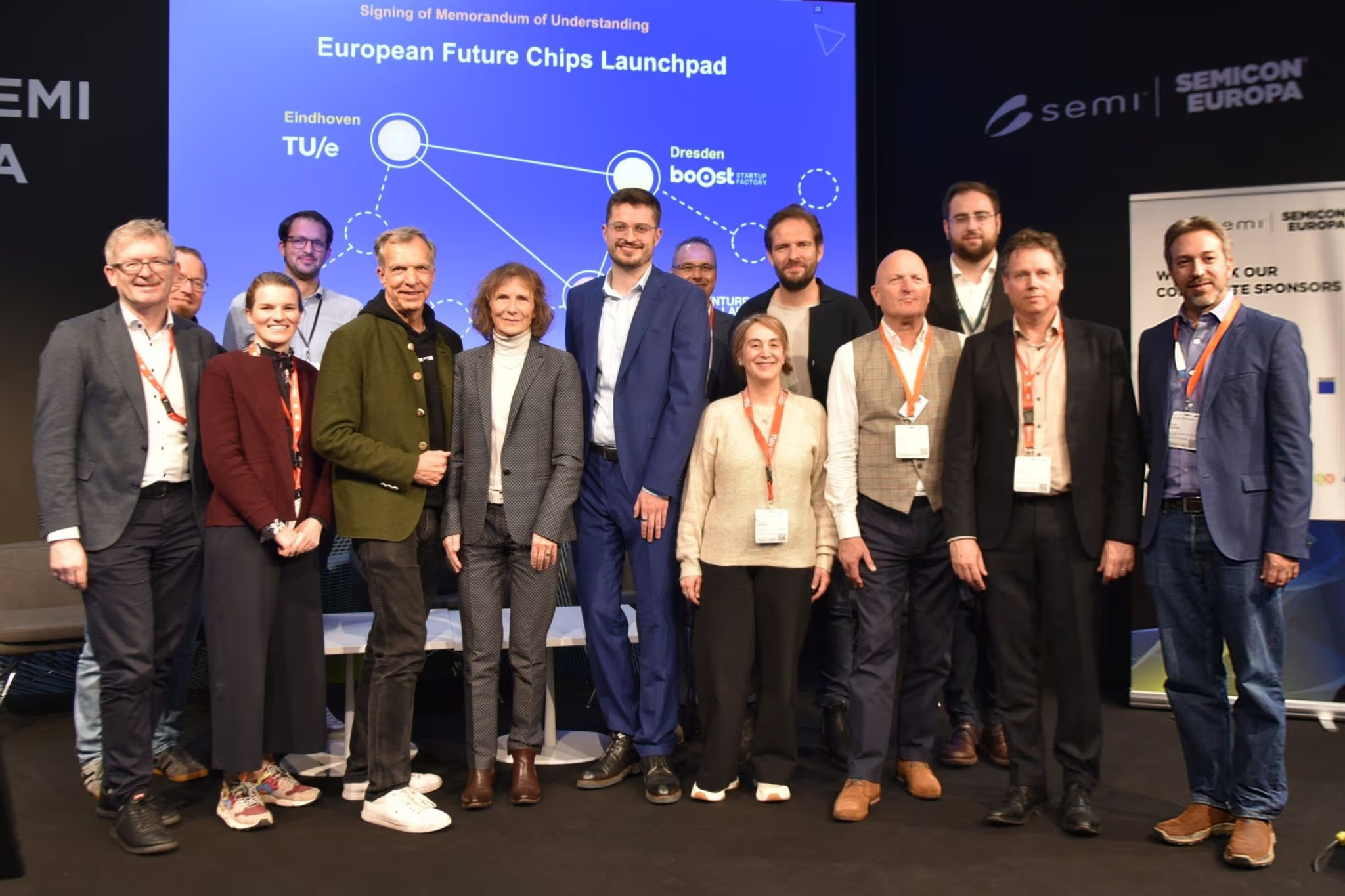
Eindhoven University of Technology, TUM Venture Labs and Dresden's Startup Factory boOst have signed a memorandum of understanding to set up the European Future Chips Launchpad (EFCL). The network has identified 14 potential startup and spin-off cases so far.
Eindhoven University of Technology (TU/e) announced on 12 November that it had signed the memorandum of understanding (MoU) with TUM Venture Labs and Startup Factory boOst at the SEMICON Europa 2026 chips conference in Munich. The EFCL is meant to speed up the creation of semiconductor, photonics and quantum technology ventures.
TUM Venture Labs is a joint initiative of the Technical University of Munich (TUM) and UnternehmerTUM that supports deep-tech startups. Startup Factory boOst is a non-profit organisation in Dresden, with TU Dresden among its shareholders, focused on technology transfer and deep-tech entrepreneurship.
A commercialisation layer, not a fund
According to TU/e, the partners do not plan another research programme or funding instrument. The EFCL is set up as a connecting layer between new ventures, industrial partners, investors and innovation ecosystems. The university states that seed funding alone is not enough and that startups also need launching customers to grow into scale-ups.
The platform covers cross-border mentoring, founder matchmaking, technology scouting, investor engagement, finding launching customers and community building across Eindhoven, Dresden and Munich. The 14 cases identified to date range from high-tech systems to quantum and semiconductor startups.
The partners call the problem they want to tackle the "lab-to-fab gap": the path from research results to investable, scalable companies. TU/e argues that too little of Europe's research in quantum, photonics and heterogeneous integration reaches the market as scalable, venture-backed companies.
Open to more ecosystems
The network is designed to grow, with an invitation to other European ecosystems including Grenoble, Leuven, Cambridge, Zurich, Copenhagen and Helsinki. The long-term aim is to develop the EFCL into a pan-European venture engine for semiconductor, quantum and photonics technologies starting in 2027, alongside initiatives such as Chips JU and the European Innovation Council.
Philipp Gerbert, chief executive of TUM Venture Labs, said: "Chip startups are international by nature."
What comes next
According to IO+, the partners have worked together informally since early 2026, running a startup exchange between the three ecosystems. IO+ reports that they plan to agree a joint operating model covering governance, roles and a work plan by the first quarter of 2027, with a two-year pilot due to start later that year. They are seeking co-funding for the pilot from sources that include the European Chips Act and industry partners.
Original source: TU/e, "TU/e, TUM Venture Labs and boOst launch initiative to strengthen Europe's indispensability in deep tech" (press release) Additional reporting: IO+, "Eindhoven, Munich, Dresden unite to grow chip startups"