
Eindhoven chemical recycler BlueAlp will double capacity at its Ostend plant and build new plants in Kampen and Rotterdam, taking its own output to around 140,000 tonnes of pyrolysis oil a year, with a €21m EU Innovation Fund grant behind the Kampen site.
Credit: this report is based on a story first published by Change Inc. Read the original at change.inc.
According to Change Inc., Eindhoven scale-up BlueAlp announced on Wednesday that it will double the capacity of its plant in Ostend, Belgium, which currently produces 24,500 tonnes of pyrolysis oil a year. The company also plans a new plant in Kampen and another in Rotterdam.
BlueAlp works in chemical recycling. It heats plastic waste in low-oxygen conditions (pyrolysis) to break it down into simple hydrocarbons, producing an oil that can be used as a building block for new plastics such as packaging film. It targets plastic waste that is not suited to mechanical recycling.
The numbers
The Kampen plant, supported in part by a €21m subsidy from the EU Innovation Fund, will have a capacity of 50,000 tonnes and is planned for 2029. In Rotterdam, BlueAlp is developing a 40,000-tonne plant together with LBC Terminals. With these projects, the company's own production capacity grows to around 140,000 tonnes of pyrolysis oil a year over the coming years.
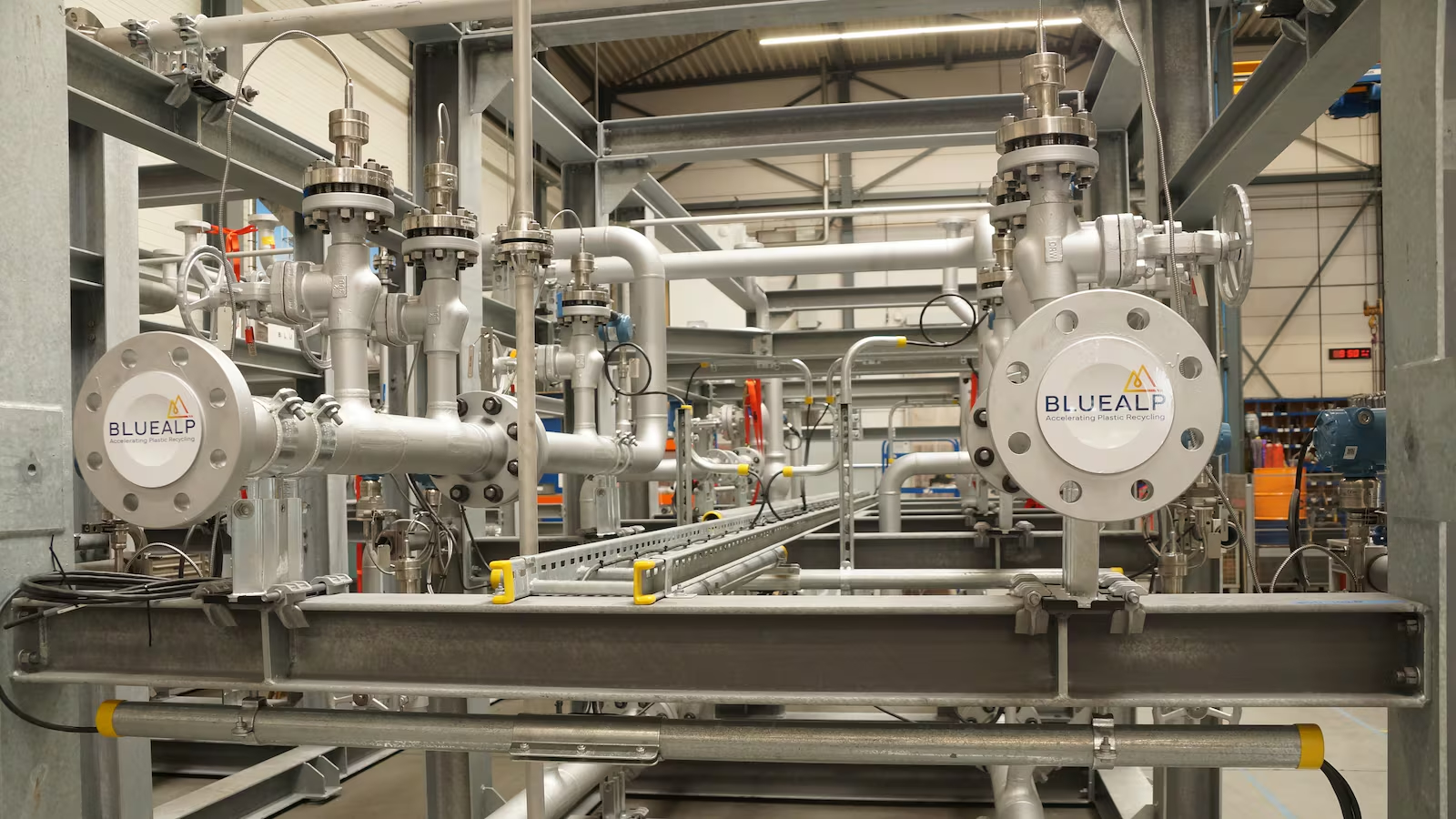
BlueAlp will run the Rotterdam and Kampen plants itself. It also licenses its technology: it has agreements with Italian waste processor RES and with biochemicals company BioBTX in Delfzijl. Plant components such as reactor vessels and pipework are made in Eindhoven.
Who is on the cap table
CEO Valentijn de Neve told Change Inc. that existing shareholders Borouge International, Shell, Rumali, Den Hartog and Mourik are prepared to invest further. He said the risk of working with the new technology is falling while the market outlook improves, and that this is also why the new projects qualify for bank financing, with the EU grant giving an extra push.
The company has existed since 2014 and built an early demonstration facility in Switzerland. De Neve said the hardest stage was the move from a lab-scale demonstration to a commercial plant, and that BlueAlp took it slowly on purpose. "You have to scale up once the foundation is really in place," he said (translated from Dutch).
What comes next
BlueAlp already supplies customers making packaging for sectors including food and medical equipment. De Neve pointed to new EU packaging rules, which include an obligation to use at least 10% recycled plastic from 2030, as a driver of demand, and said the packaging sector is already preparing for that change.
Original source: Change Inc., "Plastic recycler BlueAlp uit Eindhoven schaalt fors op"