
Sencilia, a University of Groningen spinout that measures what actually flows through a drip, has raised approximately €2m in a round led by NOM, the development agency for the Northern Netherlands.
Sencilia emerged from the Engineering and Technology Institute Groningen (ENTEG) at the University of Groningen and is based at the Zernike Campus in the city. Its founder, Amar Kamat, worked as a postdoc in Professor Ajay Kottapalli's research group at the university before starting the company, building on Kottapalli's earlier work on flow sensors for monitoring IV drips.
The company's sensor, Rely-V, clips onto the outside of a standard infusion tube and measures the real flow rate down to 0.1 millilitres per hour, roughly two drops per hour. It does not touch the medication. The problem it targets: premature babies and sick children often receive medication in very small doses, and an infusion pump calculates what it delivers without directly measuring what passes through the tube.
In laboratory tests in a simulated neonatal intensive care unit, Rely-V detected a blocked infusion line within a minute, while the infusion pump took an hour or more. "We want nurses to spot such a disruption in the drip straight away," Kamat said.
The round
NOM leads the round. RUG Ventures and Triade, which invested in Sencilia when it was founded, are participating again. Future Tech Ventures, imec.istart and private investors with a background in the infusion industry also take part.
Future Tech Ventures first invested in Sencilia in August 2025. Its investment manager, Hilbrand van der Zee, said the company has since developed the technology further, sharpened its view of where the sensor makes the biggest difference and gained experience through trials with companies and healthcare professionals.
Use of funds
With the money, Sencilia is taking its prototype towards production, collecting more clinical data and seeking partnerships with manufacturers of infusion pumps and infusion sets. Several of those manufacturers are already testing the sensor on their own equipment.
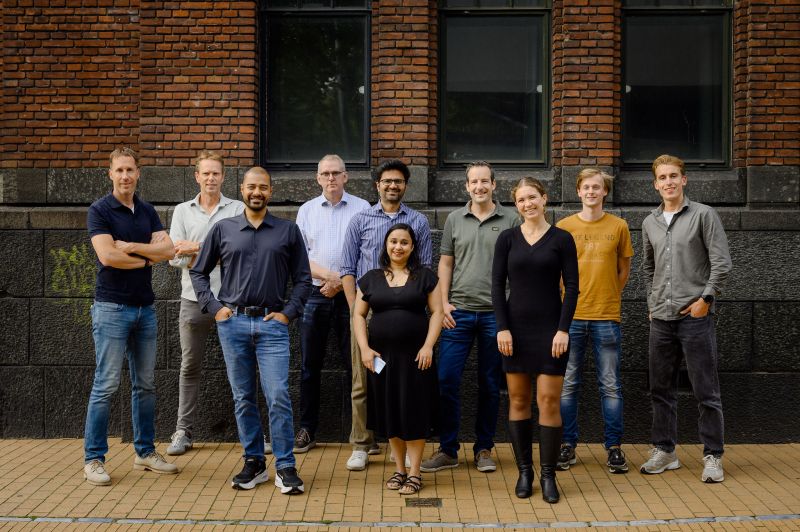
Kamat sees the round as a chance for the company to grow, with Groningen playing a big part: many team members joined as students, interns or through small projects, and the company has run several joint research projects with the university's Bioinspired MEMS and Biomedical Devices (BMBD) group.
What comes next
Sencilia works with specialist neonatal intensive care units on pre-clinical and clinical research. The next step is a clinical trial at Erasmus MC in Rotterdam, expected in the first quarter of 2027. If development and approval go to plan, the company expects the first products with the sensor to reach the market from 2028.
Original source: University of Groningen (press release), "Sensor aims to detect IV problems in premature babies at an earlier stage"